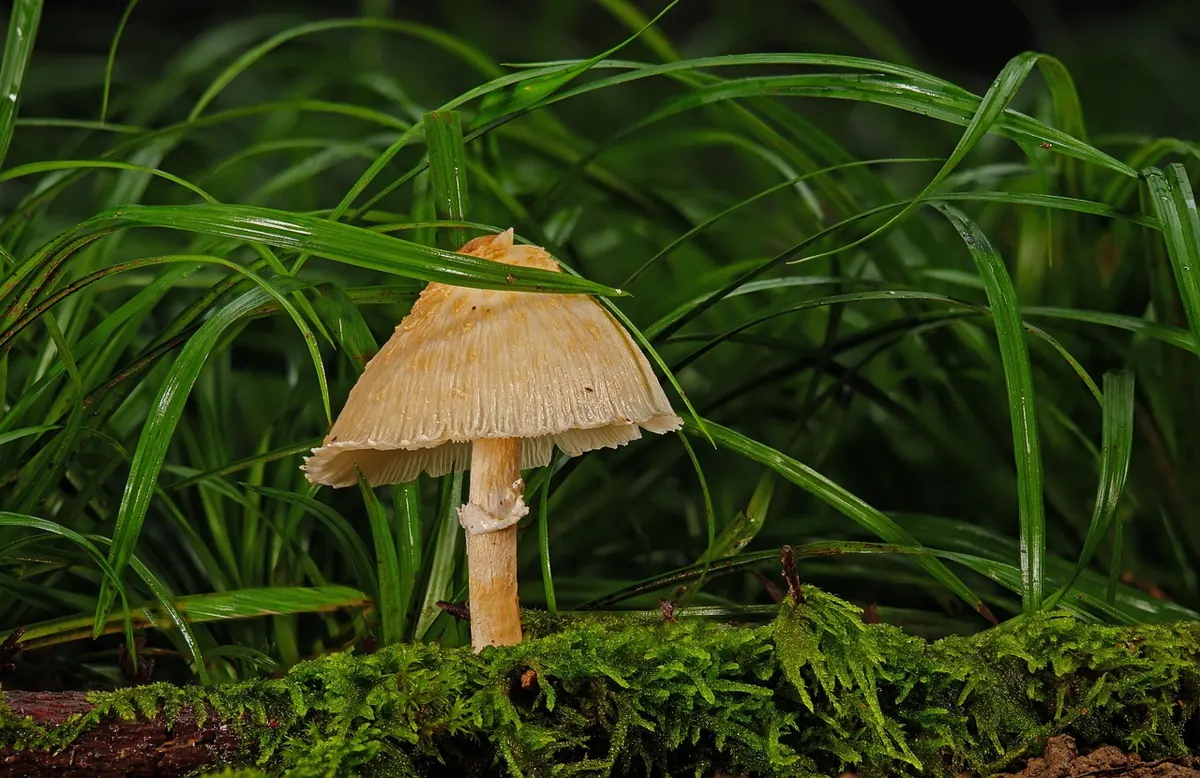
The mushrooms that land people in hospital rarely look sinister. They look like the one you already know — a puffball, a chanterelle, an innocent brown cap clustered on a stump. Most serious poisonings are not the result of reckless curiosity. They are the result of a calm, confident mistake made by someone who was sure.
You cannot memorise every species on your patch, and you don't need to. What you need is a small set of dangerous pairs, the features that separate them, and the field habits that make a wrong identification much harder to get as far as the frying pan.
That last point is worth sitting with. Many toxic mushrooms are not bitter, not foul-smelling, and not obviously marked as dangerous. The death cap is said to taste pleasant. The deadly galerina looks like a harmless brown mushroom. The green-spored parasol appears on lawns where children play. The danger is rarely a skull-and-crossbones; it is a familiar shape in the wrong place.
The Mix-Ups That Cause Real Harm
A handful of pairings account for a large share of mushroom poisonings. Learn these before you learn anything else.
Death cap and destroying angel versus buttons and puffballs
Amanita phalloides and its all-white relatives, the destroying angels, are responsible for most fatal mushroom poisonings worldwide. They hold white gills, a white spore print, a ring on the stem, and a bulb or loose sac at the base that usually sits buried under leaf litter or soil. The young fruiting body emerges enclosed in a white, egg-shaped veil.
That egg is the danger. Sliced open, a real puffball is uniform white and marshmallow-soft right through. A young Amanita sliced the same way shows the outline of a cap, gills and stem forming inside its wrapper. A button-stage death cap can also pass for a field mushroom, except that Agaricus gills turn pink and then chocolate brown and drop chocolate-brown spores, while Amanita gills stay white for life.
The toxins in Amanita phalloides are heat-stable. Cooking, frying, drying and freezing do not make them safe. Symptoms may not begin for six to twenty-four hours, and they can appear to improve before liver and kidney damage becomes severe. This delayed pattern is one reason the death cap is so deadly: by the time the first stomach cramps arrive, the poison has already been absorbed.
Morels versus false morels
Cut every morel in half from tip to base. A true morel is hollow from stem to cap, and the cap is pitted like a honeycomb. A false morel (Gyromitra) is lobed and brain-like, not hollow — its interior is chambered and cottony. It takes seconds to check, and it is the only check that matters.
False morels vary widely. Some are reddish brown, some are saddle-shaped, and some have a smooth, wavy cap. The hollow test cuts through all that variety. If the mushroom is not hollow from the very tip of the cap to the base of the stem, do not treat it as a morel. Some false morels also contain gyromitrin, which can cause seizures and liver damage, and the toxin is not always destroyed by cooking.
Chanterelles versus jack-o'-lanterns
Chanterelles have blunt, forking ridges that run partway down the stem rather than true blade-like gills. They usually fruit singly or in small numbers from soil, smell faintly of apricot, and have solid, pale or yellow flesh inside. Jack-o'-lanterns (Omphalotus) grow in dense clumps on wood or buried roots, have thin true gills, and their orange flesh is watery and thin. The gills of some jack-o'-lanterns glow faintly green in complete darkness — a lovely detail, but never the test you rely on.
A useful habit is to look at where the stem enters the ground. Chanterelles rise from soil, often among moss and leaf litter. Jack-o'-lanterns emerge from a woody base, even if that wood is buried and invisible. If you pull a cluster and find a common base attached to rotting wood, slow down. Also check the gills: chanterelle ridges are shallow, blunt and forking; jack-o'-lantern gills are sharp, thin and blade-like.
Deadly galerina versus honey mushrooms
This is the quiet one. Galerina marginata is a small brown mushroom with a ragged ring, and it carries the same class of toxins as the death cap. It grows on rotting conifer wood, often in clusters, which is exactly where honey mushrooms (Armillaria) turn up. The separation is the spore print: honey mushrooms drop white spores, deadly galerina drops rusty brown. Both grow in clusters on wood, so print every cluster you plan to keep.
Do not trust the ring alone. Galerina marginata's ring is often faint, ragged and dusted with rusty spores. Honey mushroom rings can be thick and cottony when young, but they can also vanish with age or rain. The spore print is the feature that survives weather. Place a cap gill-side down on half white and half dark paper, cover it, and wait overnight. Rusty brown means discard.
Green-spored parasol versus edible parasols
A young Chlorophyllum molybdites looks like the parasol people prize, with a brown-scaled cap and a ring. It fruits on lawns, along paths and in fairy rings, and it causes violent vomiting and diarrhea. The answer is a spore print: green, and it stays in the grass.
Other Chlorophyllum species can be edible, which makes the confusion worse. The green spore print is the reliable separator. If you are testing a lawn parasol, take a print before you cook anything. Green spores mean the mushroom is not for the table, no matter how perfect the cap looks.
Features That Actually Separate Species
When two mushrooms look alike, stop comparing caps and start comparing these:
- Spore print. White, cream, pink, brown, rusty brown, black, green. Colour alone eliminates whole families.
- Gill attachment. Free from the stem, attached, running down it, or forking ridges instead. Photographs rarely show this clearly.
- The base. Dig it out. Volvas and bulbs are usually buried, and that is where the deadliest species hide.
- The ring. Present or absent, smooth or ragged, skirt-like or a faint band.
- Habitat. Soil or wood, conifer or hardwood, and which tree it sits
Photo: adege / Pixabay